CoreWeave Shares Slump as Bond Yields Near 15%, Testing Debt-Funded AI Buildout
A 13-16% share drop and a roughly 15% yield on 2032 notes put CoreWeave's $104 billion backlog against interest costs that already exceed its adjusted operating income.
Key facts
- MarketBeat reported CoreWeave shares fell 15.5% on 14 October, from $77.81 to $65.78, on volume of about 107.5 million shares.[2]
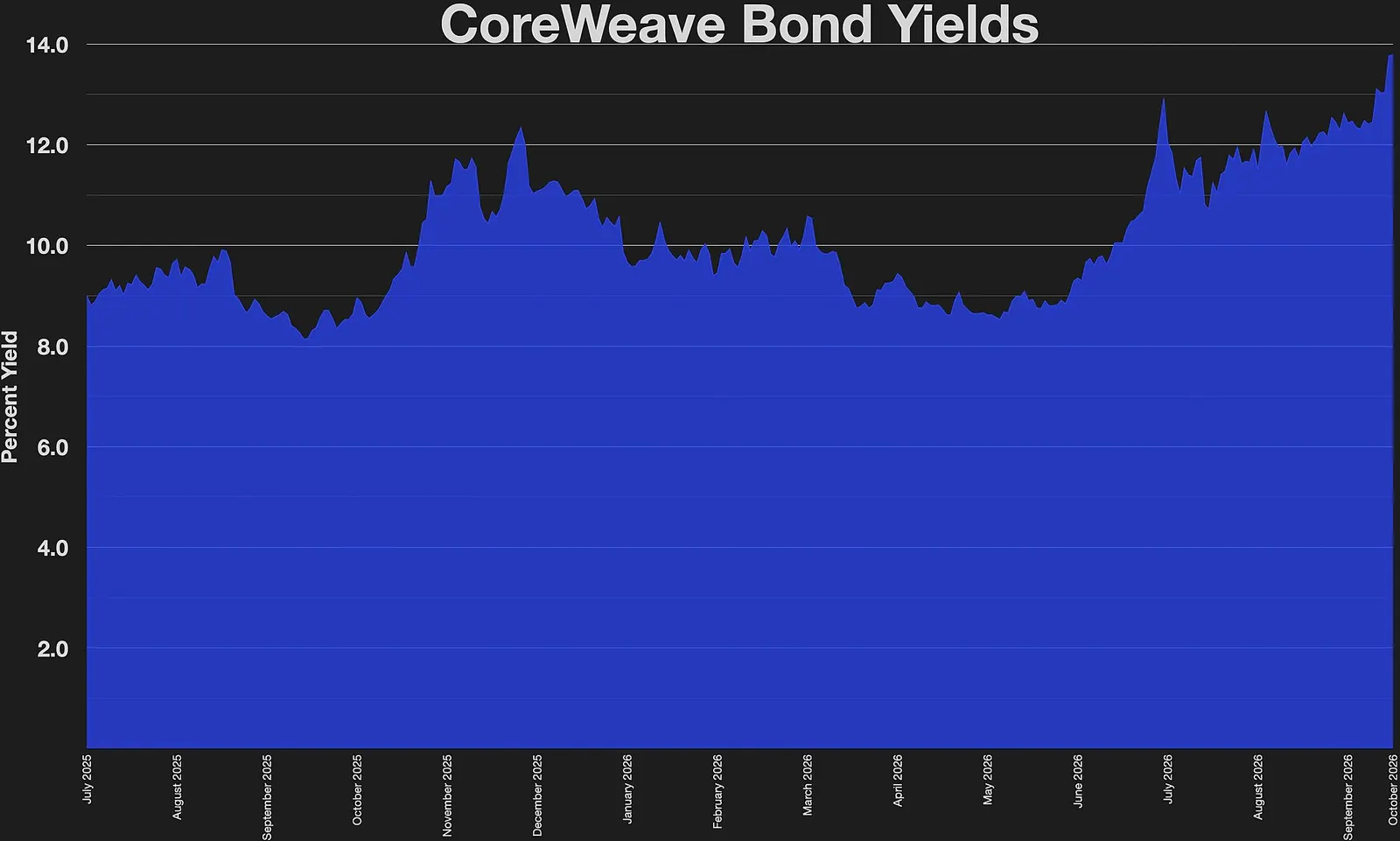
- Yields on CoreWeave's 9.625% senior notes due 2032 rose from about 13.42% to 15.06%, with the price falling from about $85 to $79.50 per $100 of face value, according to KuCoin News.[3]
- CoreWeave's second-quarter 2026 revenue more than doubled to $2.58 billion, while interest expense of about $640 million exceeded its adjusted operating income, per Crypto Briefing.[1][2]
- CoreWeave's contracted revenue backlog was about $104.2 billion as of 30 June, up 246% year on year, according to KuCoin News.[3][1]
- MarketBeat reported about $51.6 billion of CoreWeave debt against $5.5 billion in cash, and D.A. Davidson analyst Gil Luria warned the equity could theoretically be wiped out if AI spending weakens.[2]
CoreWeave shares fell about 13% to 16% on 14 October as yields on the company's bonds approached 15%, a repricing that has put the debt-funded build-out of AI computing under fresh scrutiny. MarketBeat reported a 15.5% drop to $65.78 on volume of about 107.5 million shares, roughly 273% above the average session, while yields on the company's 9.625% notes due 2032 rose to 15.06% as their price fell to about $79.50 per $100 of face value, according to KuCoin News.
The episode is a useful stress test of a simple question: can an AI cloud provider with a $104 billion order backlog afford the money it has borrowed to serve it?
What happened to CoreWeave's stock and bonds?
The figures differ by source and by the time they were measured, so the range matters. Crypto Briefing reported an intraday fall of as much as 16%, to a low near $65 to $68. MarketBeat put the decline at 15.5%, from a prior close of $77.81 to $65.78, with an intraday low of $64.41. KuCoin News reported a fall of about 13%, to a close near $67.52, the lowest close since 29 July and roughly 20% lower for October.
The bond move is the more telling signal. KuCoin reported that yields on the 9.625% senior notes due 2032 rose from about 13.42% to 15.06%, while the price fell from about $85 to $79.50 per $100 of face value. Crypto Briefing said the same notes hit a 15% yield intraday on 13 October and closed at 14.5%, and that its 9.75% notes due 2031 traded at roughly 14.9%. Both articles stress that these are secondary-market yields on specific issues, not CoreWeave's overall borrowing cost. Even so, a yield more than five points above a 9.625% coupon means investors demand far more than the company originally agreed to pay.
Why are investors worried?
The core concern, according to Crypto Briefing, is refinancing exposure. CoreWeave's second-quarter revenue more than doubled to $2.58 billion, up 112.5% year on year according to MarketBeat. Yet KuCoin reported net interest expense of roughly $640 million and a net loss of $626 million, and Crypto Briefing said the interest bill exceeded adjusted operating income for the quarter.
Leverage is heavy. MarketBeat cited about $51.6 billion of debt against $5.5 billion of cash. KuCoin, attributing the figure to the Financial Times, said CoreWeave had about $52 billion in combined debt and lease obligations as of June. The company expects 2026 capital expenditure of $35 billion to $39 billion, according to KuCoin. The sources use different definitions, so the totals should not be read as an exact reconciliation.
MarketBeat also pointed to bearish positioning. Traders have been buying what it called "bubble puts," options that pay out if AI infrastructure stocks fall further. D.A. Davidson analyst Gil Luria warned that the equity could theoretically be wiped out if AI spending weakens, MarketBeat reported.
Social media amplified the move. Venture capitalist Chamath Palihapitiya flagged the bond yields and warned of a possible private-credit bubble, and Elon Musk replied with a single word, "Yikes," according to KuCoin. MarketBeat and Crypto Briefing both said the exchange added to negative attention.
What does CoreWeave say?
The company's defence rests on its order book. Contracted revenue backlog was about $104.2 billion as of 30 June, up 246% year on year, KuCoin reported. MarketBeat said the backlog had grown by about $25 billion in six weeks. It also noted a recent $4.2 billion convertible-bond financing that could lower interest costs, though at the risk of diluting shareholders.
Backlog is not cash, however. It represents contracts for capacity that must be built, powered and delivered before revenue arrives. That is why the capital-spending plan matters: every dollar of backlog converts to revenue only after the company has financed the hardware to serve it. KuCoin's article put the central point bluntly, noting that strong contracted revenue does not offset the rising cost of funding the build-out.
CoreWeave is also reported to be exploring new sources of capital. According to the Financial Times as relayed by KuCoin, it is seeking life-insurance capital by structuring GPU-backed financing designed to earn investment-grade ratings. Crypto Briefing said the company raised roughly $30 billion to $35 billion in combined debt and equity in 2026.
Did the damage spread?
Crypto Briefing reported that Oracle fell roughly 7% and Nebius dropped about 9% to 10% on the same day, a sign that investors read CoreWeave's bond stress as a sector signal. Those moves were reported by a single source among the three reviewed here, and the sources do not attribute them solely to CoreWeave.
Analysts remain divided. MarketBeat's tally showed 23 Buy ratings, 9 Hold and 3 Sell, with an average price target of $140.64, far above the $65.78 trading price. Those ratings largely date from August and September, before the latest fall. MarketBeat also noted insider selling: about 5.85 million shares worth roughly $509.9 million over the previous 90 days, including a $4.84 million sale by chief financial officer Nitin Agrawal under a pre-arranged Rule 10b5-1 plan.
What we don't know yet
- **True borrowing cost.** The headline yields are secondary-market readings on individual bonds. They show how holders value existing debt, not what CoreWeave would pay for new financing. - **Cause of the sell-off.** The sources point to bond yields, leverage, options activity and social media, but they do not agree on a single trigger. - **Figures.** Debt totals, share-price moves and percentage declines vary between sources and between intraday and closing measures. - **Contagion.** Whether the pressure on Oracle and Nebius reflects CoreWeave specifically or broader AI-spending worries is not established.
What happens next?
Crypto Briefing named three things to watch: whether bond yields stabilise below 15%, whether adjusted operating income closes the gap with quarterly interest expense in the next earnings report, and the terms of CoreWeave's next financing round. The last is the sharpest test. If the company can raise money at prices close to its existing coupons, the sell-off may prove a sentiment shock. If new debt prices near 15%, the arithmetic of renting out GPUs on borrowed money gets harder, and the pressure will fall not only on CoreWeave but on every provider using the same model to finance the AI buildout.