

DARPA Moves IBM, IonQ, Atom and Diraq Into Quantum Benchmarking's Final Stage
Stage C shifts the agency's utility-scale test from roadmaps to hardware verification, as four rival qubit technologies join Microsoft and PsiQuantum in a 2033 race.

Key facts
- DARPA named Atom Computing, Diraq, IBM and IonQ as Stage C performers on October 7, joining Microsoft and PsiQuantum.[1]
- QBI asks whether any approach can reach utility-scale operation, where computational value exceeds cost, by 2033; Stage C tests whether proposed systems can be built as designed.[1][2]
- The $300 million figures are potential ceilings; Diraq's initial tranche is $51 million and IonQ's later funding depends on future appropriations.[2]
- Atom Computing says it has built systems with more than 1,200 qubits and Microsoft will provide algorithm support and error-correction codes.[3]
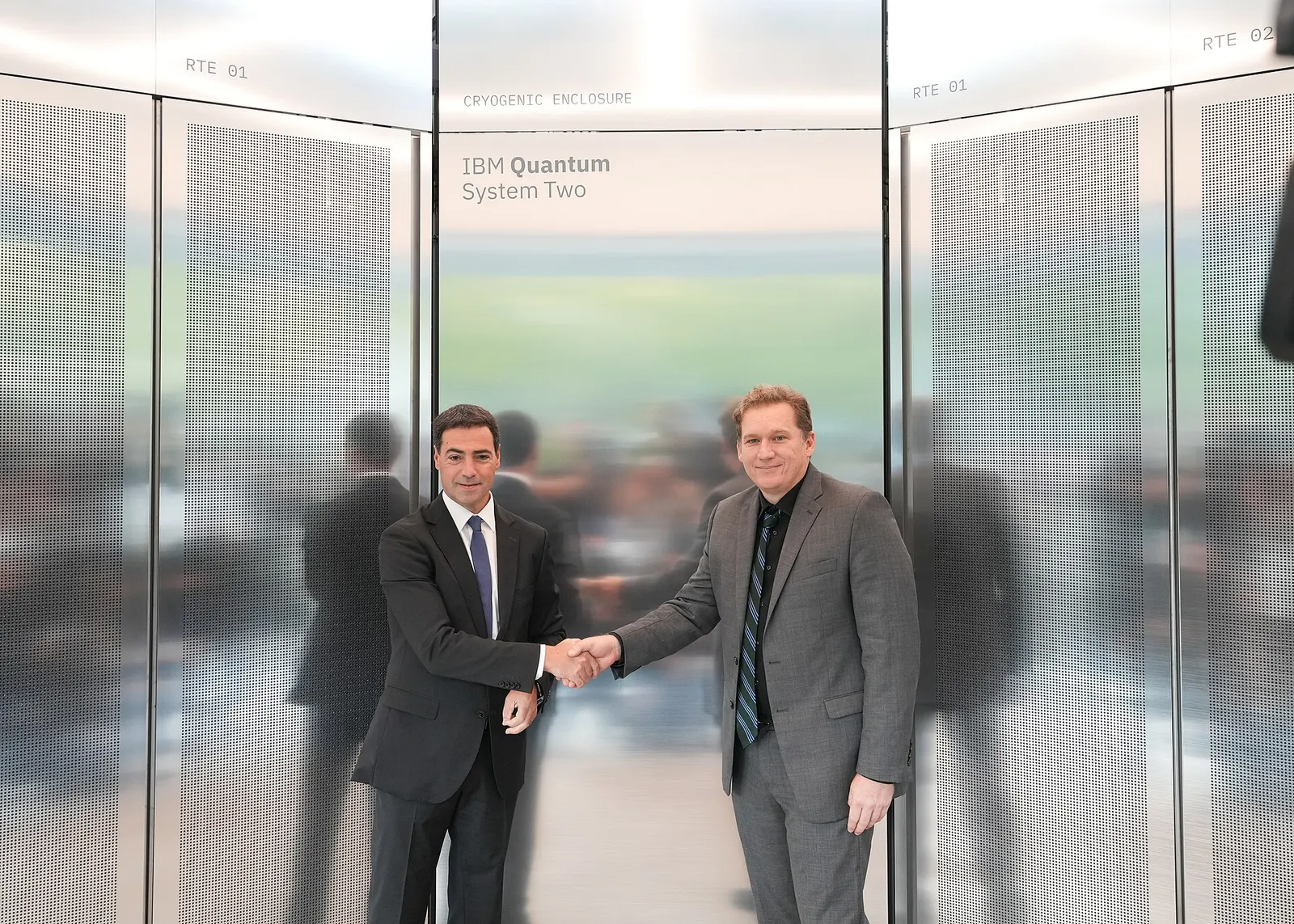
DARPA has moved four more quantum computing companies into the final stage of its Quantum Benchmarking Initiative, the clearest signal yet from the U.S. government about which hardware roadmaps it considers worth testing in hardware rather than on paper. In an announcement dated October 7, the agency named Atom Computing, Diraq, IBM and IonQ as Stage C performers. They join Microsoft and PsiQuantum, which entered through a predecessor pilot, making six publicly identified companies at this level.
The selection matters less as a prize than as a change in the kind of evidence being asked for. Stage C is where a government team begins checking whether the machines can actually be built as described.
What Stage C is, and is not
QBI launched in mid-2024 with a deliberately blunt question: can any approach reach "utility-scale operation," defined by DARPA as computational value that exceeds cost, by 2033? According to DARPA, the program has evaluated more than 20 companies. Stage A is the entry point, Stage B was a yearlong review of detailed research and development plans, technical risks and the prototypes needed to show progress, and Stage C has a government evaluation team working with each performer to test whether its proposed system can be built as designed and operated as intended.
Micah Stoutimore, the QBI managing director, framed the step in a single line: "Stage C is where we begin moving from plans to proof." He also said that "we increasingly expect that someone will build a utility-scale quantum computer by 2033." As PostQuantum reports, DARPA's September 2024 briefing had described the goal as unlikely, and Stoutimore said in March 2026 that someone appeared likely to achieve it.
DARPA stresses that QBI is not a competition and is not meant to pick winners and losers; each path is assessed on its own merits. PostQuantum also notes that DARPA does not expect Stage C to deliver a finished utility-scale computer. The intended endpoint is enough evidence from components and prototypes, with major risks reduced, to justify finalizing a system design and starting manufacture.
Four bets on four technologies
The four new entrants represent four different physical approaches, which is part of the point of the program.
Atom Computing, based in Boulder, Colorado, builds scalable arrays of neutral atoms. The Next Web reports that the company cites potential funding of up to $300 million for the stage, that Microsoft will supply algorithm support and error-correction codes, and that the company says it has built systems with more than 1,200 qubits. PostQuantum adds that a June preprint from the company reported toric-code error-correction tests of up to 90 syndrome-extraction cycles with lost-qubit replacement, though evidence of lower logical error rates came from shorter runs of up to eight cycles. A preprint is not peer-reviewed.
Diraq, based in Sydney, makes spin qubits on silicon using chip-manufacturing processes. PostQuantum reports an initial $51 million tranche for the next year within a potential $300 million, and targets of 150,000 physical qubits in 2029 and more than two million on one chip in 2031. Its most recent peer-reviewed result cited there is a July Nature Communications paper on control and readout of an eight-qubit array made in a 300 mm CMOS-compatible foundry process, with a controlled-phase gate demonstrated on one adjacent pair.
IBM, listed by DARPA at Yorktown Heights, New York, pursues modular superconducting processors. PostQuantum says IBM's stated target is a fault-tolerant system called Starling in 2029 with 200 logical qubits, and that no IBM-specific award or Stage C duration was disclosed.
IonQ, of College Park, Maryland, uses trapped ions. PostQuantum reports an agreement worth up to $300 million through 2029, with later funding contingent on future appropriations and DARPA funding actions, and notes IonQ's cited milestones include fabricating its first integrated 256-qubit chips at SkyWater and trapping the first ions in prototype systems.
Read the dollar figures carefully
The $300 million numbers deserve caution. PostQuantum describes them as ceilings rather than committed amounts, and the original DARPA briefing listed that figure subject to conditions. Only Diraq's initial tranche is specified in the reporting reviewed here, and DARPA's own announcement does not mention funding at all. Headline totals are the upper bound of a staged relationship, not cash delivered.
The economic test is also narrower than it sounds. PostQuantum notes that DARPA's criterion counts construction and operating costs but excludes research and development spending. A machine could therefore clear the utility bar on paper while the road to building it remains expensive. Economic utility is also a different threshold from cryptanalytic capability, and the announcement sets no new date for breaking widely used encryption.
Who is not on the list
Absence from this round is not rejection. DARPA describes advancement as staggered and says it expects additional companies to advance to Stage C in the near future as Stage A and B performers progress. PostQuantum notes that the November 2025 Stage B cohort included Quantinuum, QuEra, Photonic Inc. and Xanadu, none of which appear in this announcement. The agency's page does not name Stage B performers that did not advance, so any reading of their status is inference.
Why it matters and what comes next
For the companies, Stage C is a credibility event with commercial consequences. The Next Web notes the context of a May U.S. agreement to back nine quantum companies with $2 billion in exchange for equity stakes, which means government validation now sits alongside government capital. Favorable independent verification would give a performer a persuasive answer to the question buyers keep asking: does the roadmap survive contact with engineering?
For the field, the more interesting consequence is diversification. DARPA is now testing superconducting, trapped-ion, neutral-atom, silicon-spin, photonic and Majorana-based designs in parallel. If one approach reaches its milestones and others stall, the evidence will be public enough to reshape private funding quickly. If several succeed, the 2033 goal looks less like an aspiration and more like a procurement schedule.
The things to watch are concrete. First, whether further promotions bring Quantinuum, QuEra or others into Stage C. Second, whether DARPA publishes its test criteria, which the announcement does not state. Third, whether company milestones, such as IBM's 2029 target, begin to appear in independently verifiable form. Stage C is where plans are meant to turn into proof, and over the coming year the claims of six companies will start to be measured against hardware.