

Google Demonstrates Magic State Cultivation on Willow, Cutting Errors 40-Fold
Google Quantum AI reports a 99.99% logical-fidelity T-state in a Science paper, a first hardware test of a cheaper route to fault tolerance, though the method still needs to be proven at scale.
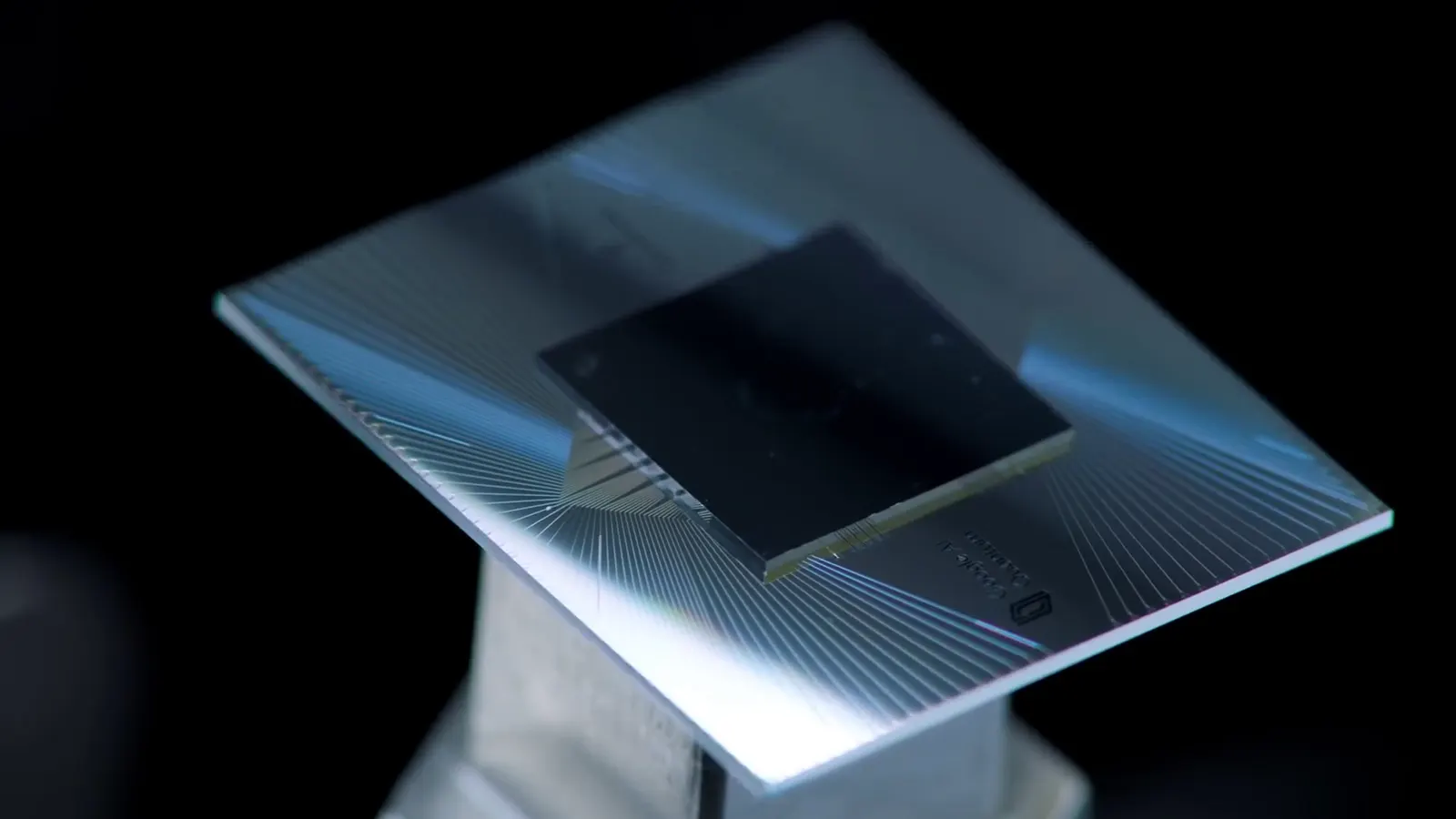
Key facts
- Google Quantum AI reported a roughly 40-fold error reduction and 99.99% logical fidelity for T-states using magic state cultivation on its 105-qubit Willow processor, in a paper published in Science.[1][2]
- Some estimates put the cost of producing magic states at up to 95% of a quantum computer’s capacity, according to Google.[1][3]
- Only about 8% of cultivation attempts passed every check, and the grafting experiment used at most 54 of Willow’s 105 qubits.[3][2]
- A storage test in Google’s grafting experiment showed logical error rates about seven times higher than simulations predicted, likely due to leakage, according to The Quantum Insider.[2]
- Factoring an RSA-2048 key would require magic states roughly a million times cleaner than the result Google achieved, Decrypt reported.[3]
- Project Eleven chief executive Alex Pruden said the result does not necessarily change Q-day timelines because the technique was already assumed in prior resource estimates.[4]
Google Quantum AI reported on 15 October 2026 that it has demonstrated "magic state cultivation" on its 105-qubit Willow processor, cutting errors roughly 40-fold relative to un-cultivated states and reaching a record 99.99% logical fidelity for T-states, according to Google's research blog. The work was published in the journal Science, and it is the first hardware test of a technique that until now existed only in theory and simulation.
The result targets one of the most expensive line items in fault-tolerant quantum computing. It is also incremental: Google's own authors say the method must still be shown at larger scale before it supports practical machines.
What are magic states, and why do they matter?
Error-corrected quantum computers can perform some operations cheaply, but universal computation also needs "magic states", special resource states that are consumed when a machine runs certain gates. Each one is single-use. Google's post says some estimates put the cost of producing them at up to 95% of a quantum computer's capacity, which would leave little room for the computation itself, as Decrypt reported.
The standard answer has been distillation, proposed by Sergey Bravyi and Alexei Kitaev in 2004. It turns many noisy magic states into fewer clean ones, but requires large dedicated qubit "factories". Cultivation, proposed in 2024 by Google researchers Craig Gidney, Noah Shutty and Cody Jones, is meant to be a cheaper alternative. According to Decrypt, the original paper suggested distillation "may never be needed in practice."
How does cultivation work on Willow?
Cultivation acts as a filter. A rough magic state is injected into a small patch of the chip, a series of coordinated measurements checks it, and any attempt with a detected flaw is discarded. Survivors are grown into a purer state that can be moved into a larger error-correcting code, per Google's description.
The Quantum Insider reported that the experiments ran on Willow, a 105-qubit superconducting processor with a square lattice. The headline 40-fold figure applies to this state-preparation task and is not a 40-fold gain for the processor overall, the outlet noted. Reinforcement learning was used as a final calibration step to tune the controls and lower the rate at which the circuit flagged errors; for the roughly one-in-10,000 error experiment, training took about four hours before data collection began.
The team also moved cultivated states from a distance-3 color code into a distance-5 surface code, the second a more strongly protected encoding. The distance-5 experiment used 54 qubits. Google presents this as evidence that purified states can be passed between the two code types on real hardware.
What does the cost look like?
Filtering has a price. Decrypt reported that only about 8% of attempts passed every check, meaning the chip discards more than nine of every ten tries to keep one clean state. The retained fraction matters for overall cost alongside fidelity, The Quantum Insider noted, so the headline fidelity does not by itself settle how cheap the approach is at scale.
A second caveat concerns storage. After extra rounds of error correction, the logical error rate in the grafting experiment was about seven times higher than simulations predicted, according to The Quantum Insider. The likely cause was leakage, where qubits leave their two computational states; the simulations omitted leakage, the circuits had no leakage-removal operations, and readout was not optimised for that configuration.
A measurement problem along the way
Google's post describes an unusual obstacle. Early data appeared to contradict physics. Research scientist Emma Rosenfeld traced the problem to an incorrect assumption in the benchmarking method, driven by noise from equipment drift and temperature variation. The team added control to reduce that noise and built a new benchmark that uses cultivation to measure itself, which The Quantum Insider calls "kickback tomography".
Why does it matter for cryptography?
Cultivation is one of the techniques behind Gidney's 2025 estimate that RSA-2048 could be broken with fewer than one million noisy qubits, a 20-fold drop from his 2019 estimate of 20 million, Decrypt reported. The article also cited a March 2026 Google Quantum AI whitepaper, co-authored with Justin Drake of the Ethereum Foundation and Stanford's Dan Boneh, that estimated breaking Bitcoin's elliptic-curve cryptography would take fewer than 500,000 physical qubits.
The distance to that scenario remains large. Decrypt said factoring an RSA-2048 key would require magic states with errors near one in 10 billion, roughly a million times cleaner than the present result. The Block quoted Alex Pruden, chief executive of Project Eleven, as saying the result does not necessarily change Q-day timelines because the technique was already assumed in prior resource estimates. He argued it "does validate those assumptions". Nic Carter of Castle Island Ventures told the outlet that "There's no imminent threat", while saying AI is "meaningfully accelerating the rate of progress".
The Block also noted that Coinbase published technical priorities for Bitcoin's post-quantum transition earlier in the week, arguing that preparation should begin now because the process will be complex and take years. Google previously set an internal goal of moving to post-quantum cryptography by 2029, according to the same report.
What happens next?
Google says the next step is running cultivation at larger scale. According to Decrypt, the team projects that halving Willow's underlying hardware noise would reduce magic-state errors to about two in 100,000, because those errors scale with the cube of the chip's noise level. That is a projection, not a measurement.
For the industry, the practical question is how much of a future machine's qubit budget magic-state production consumes. If cultivation holds up at scale, it could shrink the dedicated factories that distillation requires, lowering the hardware bar for useful fault-tolerant machines. If leakage and the low retention rate prove harder to fix than Google expects, the saving shrinks.
What we don't know yet
Several points are unsettled. Google has given no timeline for commercially useful machines. The scaled-up demonstrations that the authors call necessary have not been run. Figures here come from Google's blog post and press coverage of it; the underlying Science paper was not independently reviewed for this article. Outlets also differ on dates: Google's post is dated 15 October, while some coverage is dated 16 October.
Readers should treat the 40-fold and 99.99% numbers as results from a single device on a narrow task. They show that a long-theorised method works on hardware. They do not yet show that it makes large-scale quantum computing cheap.

