UN Council Renews Darfur Arms Embargo for Two Months, Shelving U.S. Push for Nationwide Ban
Resolution 2830 passes unanimously but leaves Sudan's war outside the sanctions regime, as Russia and China resist the American proposal to widen the embargo.
Key facts
- Resolution 2830 was adopted unanimously, extending the Darfur sanctions regime to December 11 and the panel of experts to January 11, 2027.[1][3]
- The council did not approve the U.S. proposal to extend the arms embargo to all of Sudan; Russia and China opposed it.[1][3]
- Russia's Anna Evstigneeva said Moscow would not allow any broadening of restrictions, and Sudan's ambassador argued a total embargo conflicts with the UN Charter's self-defence guarantee.[1][2]
- The previous renewal on September 11 was for one month while negotiations on a nationwide ban continued.[2]
- Casualty estimates differ: at least 59,000 killed per Al Jazeera, an estimated 150,000 per a UN information centre figure cited by the Defense Post; both cite over 13 million displaced.[1][3]
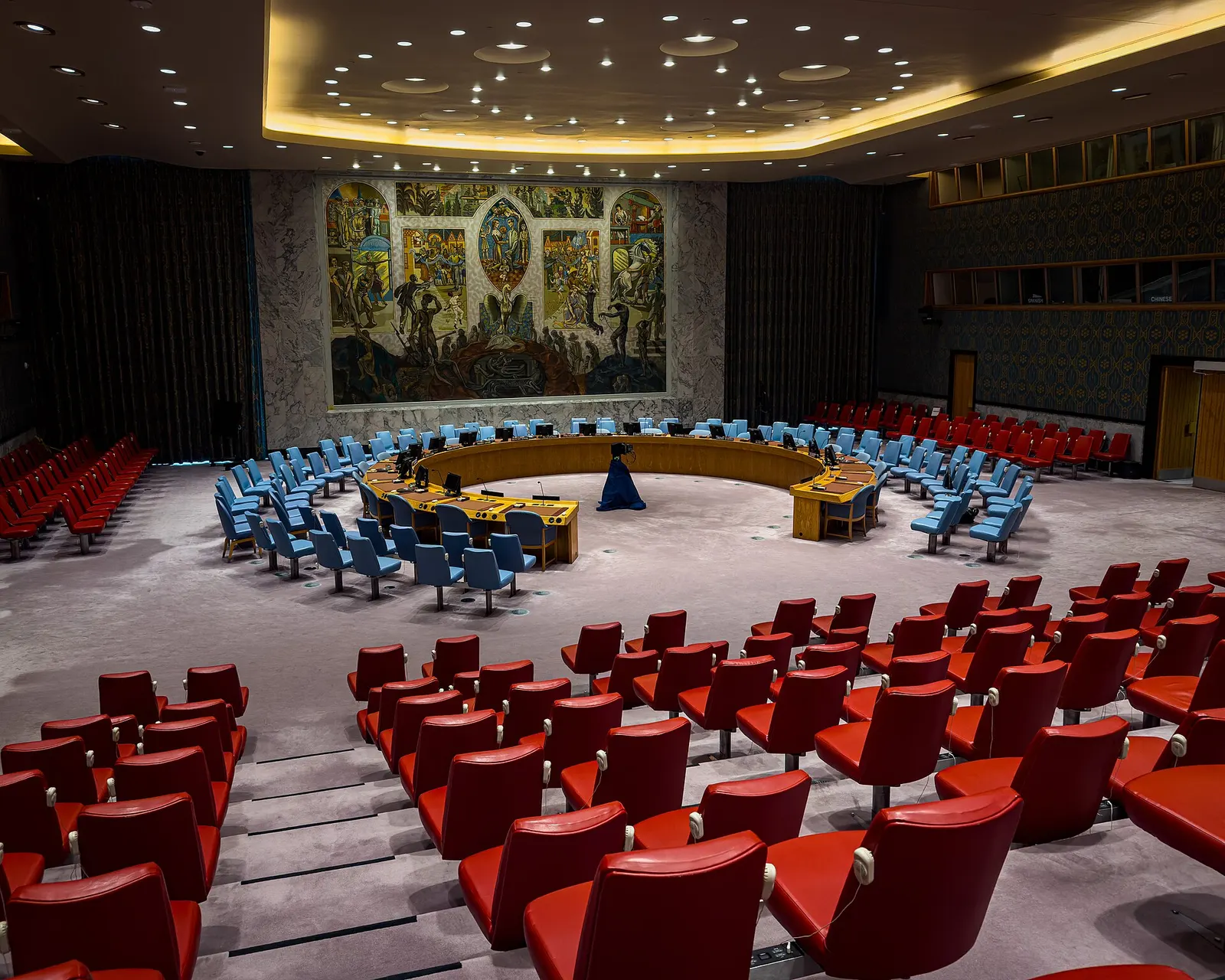
The UN Security Council has again chosen continuity over reform on Sudan. According to Al Jazeera's report of the vote, Resolution 2830 was adopted unanimously and keeps the Darfur sanctions regime in force until December 11, while extending the mandate of the panel of experts that monitors it to January 11, 2027. The council did not approve a U.S. proposal to widen the arms embargo to all of Sudan; Russia and China opposed it. The United Nations described the decision as a short-term "technical rollover," in the words quoted by Al Jazeera.
The outcome is modest on paper and significant in practice. Sudan's war between the army and the paramilitary Rapid Support Forces (RSF) is now in its fourth year, and the one sanctions instrument the council has for it was designed for a different conflict. Two consecutive short renewals, one month in September and two months now, show that the argument over what that instrument should cover has not been settled and is being deferred rather than resolved.
What the council actually decided
The sanctions regime dates to 2005 and Resolution 1591. As Al Jazeera describes it, the regime includes an arms embargo on armed actors in Darfur, a travel ban and asset freeze on designated individuals and entities, and a five-member panel of experts. Its geographic scope is Darfur, the western region roughly the size of Spain, not the whole of Sudan.
The latest resolution extends that structure unchanged. The Defense Post, citing Al Jazeera, reports that all 15 council members approved it and that the extension is intended "to allow further negotiations." That phrasing matters: it indicates the council is buying time for talks over the American proposal, not closing the file.
The previous step followed the same pattern. In September, the council voted unanimously to extend the Darfur embargo by one month while negotiations continued on a nationwide ban.
The American proposal
Washington's case, as set out by Ambassador Jeff Bartos and reported by Al Jazeera, is that "the current sanctions regime is over 20 years outdated." The United States wants the arms embargo extended across Sudan's entire territory. According to the September report, it also wants new listing criteria covering conflict-related sexual violence, kidnapping for ransom and attacks on humanitarian personnel, and a stronger mandate for the panel of experts. At an August 24 council meeting, the same report says, the United States had urged a countrywide embargo as a way to push the army and the RSF toward negotiations.
Why Russia, China and Khartoum object
Opposition is organized around two arguments, one legal and one tactical.
The legal argument comes from Sudan's government. Its UN ambassador, Al-Harith Mohamed, argued that a total arms embargo conflicts with the UN Charter's guarantee of the right to self-defense and with states' right to produce and acquire weapons to protect their sovereignty, according to Al Jazeera's September report.
The tactical argument comes from Moscow. Russia holds a veto and, in Al Jazeera's description, backs the Sudanese government against the RSF. Deputy UN Ambassador Anna Evstigneeva said Russia's "red lines" had been made clear in closed consultations and that "we will not allow even a hint of broadening the restrictions by the council on Sudan." She also questioned the timing, saying government forces "have a definite advantage on the ground" and noting that the United States did not push for the measure in 2023, when, in her account, the RSF threatened Khartoum. China, per Al Jazeera, joined Russia in opposing the expansion, though the report gives no direct quote from Beijing.
These are positions, not findings: the sources reviewed do not independently assess the military balance, and the American framing of the embargo as a lever for negotiation is a stated rationale, not a demonstrated effect.
The war the sanctions are meant to address
Fighting between the army and the RSF began in April 2023. Al Jazeera reports that at least 59,000 people have been killed, while cautioning that aid groups say the true toll could be much higher. Casualty figures differ by source: the Defense Post, attributing its numbers to a UN information centre, cites an estimated 150,000 deaths. Both outlets put displacement at more than 13 million people and report famine conditions in parts of the country. None of these figures has been verified independently here, and the gap between them illustrates how little reliable counting is possible in a conflict with limited access.
Al Jazeera describes the geography this way: the army holds central and eastern Sudan, and the RSF controls Darfur and parts of the south. Darfur has seen attacks on displacement camps and repeated ethnic massacres, according to the report, which also links to a July 2026 story on a UN probe finding that mass killings and gang rapes by the RSF amounted to genocide.
The Defense Post adds that UN investigators published findings last month saying foreign companies and recruitment networks help supply the warring parties with weapons, drones, training and military personnel, and that foreign-supplied drones have been used in attacks that harmed civilians and damaged homes, hospitals, schools, markets and shelters. The UN has warned that some of those attacks may amount to war crimes.
What happens next
The practical effect of Resolution 2830 is to set a calendar. The regime expires December 11, and the panel of experts, whose reporting underpins any future listings, runs to January 11, 2027. Between now and then, the council must decide whether to roll the regime over again, reach a compromise, or let the American proposal come to a vote that Russia could veto.
Three questions will determine which path it takes. First, whether Washington narrows its proposal, for example by pursuing the new listing criteria separately from a nationwide embargo. Second, whether Beijing, which joined Moscow in opposing expansion, treats the issue as a firm red line or as a bargaining position. Third, whether the army and the RSF show any movement in separate negotiations.
The deeper issue is that the existing embargo can only restrain what it covers. If foreign suppliers are indeed feeding both sides, as the UN investigators cited by the Defense Post say, a regime confined to Darfur reaches only part of that flow. Until the two sides of that argument converge, the council's output is likely to remain what it was this week: unanimous, brief and reversible.