Alphabet Shares Slide After Q3 as Cloud Revenue Doubles to $30.7 Billion but Free Cash Flow Turns Negative
Google Cloud grew 103%, but a 25% revenue rise could not offset an earnings miss, a $9.1 billion free cash flow deficit and guidance that 2027 capital spending will rise significantly.
Key facts
- Google Cloud revenue rose 103% to $30.7 billion in the third quarter of 2026, with operating margin widening from 23.7% to 36.2%.[1][3]
- Alphabet spent $51.4 billion on capital expenditure in the third quarter, more than the $42.3 billion of operating cash flow, leaving free cash flow at negative $9.1 billion.[1][3]
- Alphabet kept its 2026 capex guidance at $195 billion to $205 billion, and Chief Financial Officer Anat Ashkenazi said capex will increase significantly in 2027.[2][3]
- Alphabet raised $28.7 billion from senior notes and $12.4 billion from at-the-market share sales in the third quarter, and bought back no shares.[1][3]
- Alphabet shares fell 8.25% in after-hours trading on 28 October, according to XTB, while CNBC-sourced coverage reported a drop of more than 10%.[1][2]
Alphabet shares fell sharply after the company reported third-quarter 2026 results on 28 October, as a 103% jump in Google Cloud revenue to $30.7 billion was overshadowed by an earnings miss, negative free cash flow of $9.1 billion and a warning that capital spending will rise significantly in 2027. The drop was 8.25% in after-hours trading, according to XTB, while CNBC-sourced coverage on PrimeXBT put it above 10%.
The quarter is a clean test of how far investors will fund an AI build-out whose revenue is visible but whose cash cost is rising faster.
What did Alphabet report?
Revenue was $127.6 billion, up 25% from a year earlier and slightly below analysts' expectation of about $128 billion, per XTB. Operating income was $40.6 billion, up 30%, and the operating margin rose from 30.5% to 31.8%. Net income fell 25% to $26.2 billion, or $2.12 per share. XTB attributed the decline mainly to an $8.7 billion loss on equity investments, which cut earnings per share by $0.55; Alphabet did not say which holdings caused it.
The reported figures differ by source. XTB compared the $2.12 per share with expectations near $3.00. PrimeXBT, citing CNBC, used adjusted earnings of $2.67 against $3.02 expected by analysts polled by LSEG, and called it the company's first miss on both revenue and earnings in nearly four years. The gap comes from the investment loss and different definitions, so the two numbers should not be read as contradictory.
Search revenue was $63.4 billion, up 12%, against $64.96 billion expected, according to PrimeXBT. XTB reported that search query growth was the fastest in five years. YouTube advertising reached $11.2 billion, up 9%. Alphabet also said the Gemini app passed one billion monthly users.
How big was the cloud result?
Google Cloud revenue reached $30.7 billion, up 103% from $15.2 billion, as FourWeekMBA reported from Alphabet's release and slides. Operating income rose from $3.6 billion to $11.1 billion, and the margin widened from 23.7% to 36.2%. The prior quarter's growth rate was 82%, per XTB.
Chief Financial Officer Anat Ashkenazi said on the earnings call that the cloud backlog stood at $561 billion in the third quarter, up from $514 billion in the second, as quoted by FourWeekMBA. Alphabet expects just over 55% of that backlog to be recognised as revenue over the next 24 months. Jefferies analyst Brent Thill said cloud was the only segment to beat expectations, and not by much, according to PrimeXBT. Cloud revenue was above the $28.7 billion that analysts expected.
Why did cash flow turn negative?
Capital expenditure was $51.4 billion in the quarter, up from $24.0 billion a year earlier, FourWeekMBA reported. That was below the $55.09 billion analysts expected, per PrimeXBT, but it exceeded operating cash flow of $42.3 billion. The result was free cash flow of negative $9.1 billion. Quarterly capex has climbed from $27.9 billion to $35.7 billion, $44.9 billion and $51.4 billion, and the nine-month total is $132.0 billion.
Ashkenazi attributed part of the free cash flow shortfall to a build-up of inventory of the company's TPU accelerators and a $5.2 billion payment for a 2018 European Commission fine, according to FourWeekMBA. Free cash flow in the second quarter was negative $5.9 billion.
Alphabet has funded the gap with capital markets. Net proceeds from senior notes in the quarter were $28.7 billion, and at-the-market share sales raised $12.4 billion, split between $4.3 billion of Class A and $8.1 billion of Class C stock, per FourWeekMBA. Long-term debt was $125.1 billion at 30 September, against $46.5 billion at the end of 2025. Alphabet bought back no shares in the quarter, compared with $11.5 billion a year earlier.
What is guided for next year?
Alphabet left its 2026 capex range at $195 billion to $205 billion. Ashkenazi said on the call, "We continue to expect our capex to increase significantly in 2027," per PrimeXBT. Hitting the range implies fourth-quarter capex of $63 billion to $73 billion, FourWeekMBA calculated; that is the outlet's arithmetic, not company guidance. PrimeXBT reported that annual spending is expected to top $300 billion in 2027, though the quotation above does not give a number, and that figure should be treated as reported by that outlet rather than confirmed by Alphabet.
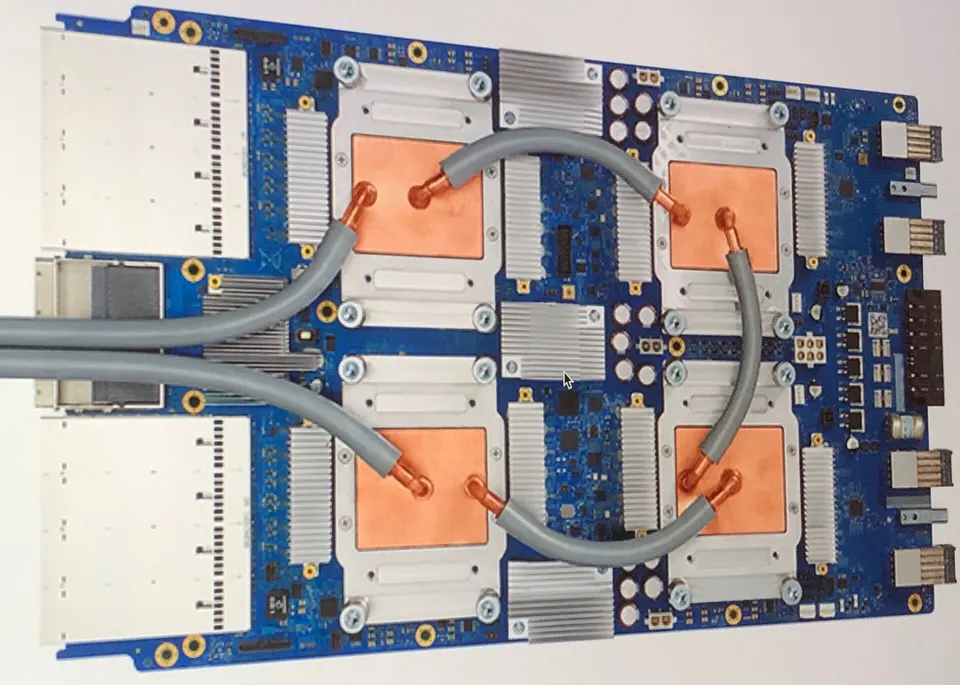
The company also disclosed future purchase commitments of $924 billion, and said it began using third-party compute at the end of the quarter, which it expects to create near-term margin headwinds. It expects TPU revenue to ramp meaningfully in 2027, FourWeekMBA reported.
Why the market reacted this way
XTB tied the sell-off to weaker earnings, negative free cash flow and concern about further capex increases, writing that investors are no longer rewarding AI growth and spending alone. The facts support that reading. Revenue growth of 25% is strong for a company of Alphabet's size, and cloud profit nearly tripled. But cloud is now producing the profit that pays for a spending programme that the company's own cash generation cannot cover, and the balance sheet has changed to match.
Long-term debt of $125.1 billion is nearly six times the $21.6 billion PrimeXBT reported for a year earlier, and its comparison with the $46.5 billion at the end of 2025 given by FourWeekMBA uses a different baseline. The two figures are both consistent with a rapid rise in borrowing. The cessation of buybacks matters too, because repurchases were a core part of the Alphabet equity story.
What we don't know yet
Several points remain unresolved. Sources disagree on the size of the share drop, from about 7% to more than 10%, and on which earnings-per-share figure to use. A Phemex item described the fall as a record that erased about $500 billion of market value, but it cited an unverified social-media post and is not confirmed here. Alphabet's own earnings release and its filing with the Securities and Exchange Commission are the authoritative documents for exact figures; the coverage here relies on press and market-analysis summaries of them.
The next data point is the fourth-quarter report. If capex lands in the $63 billion to $73 billion band while cloud growth stays near 100%, investors will learn whether backlog converts to revenue fast enough to carry $300 billion of annual spending.